National scale · Social responsibility · Ankara / Pristina 2026
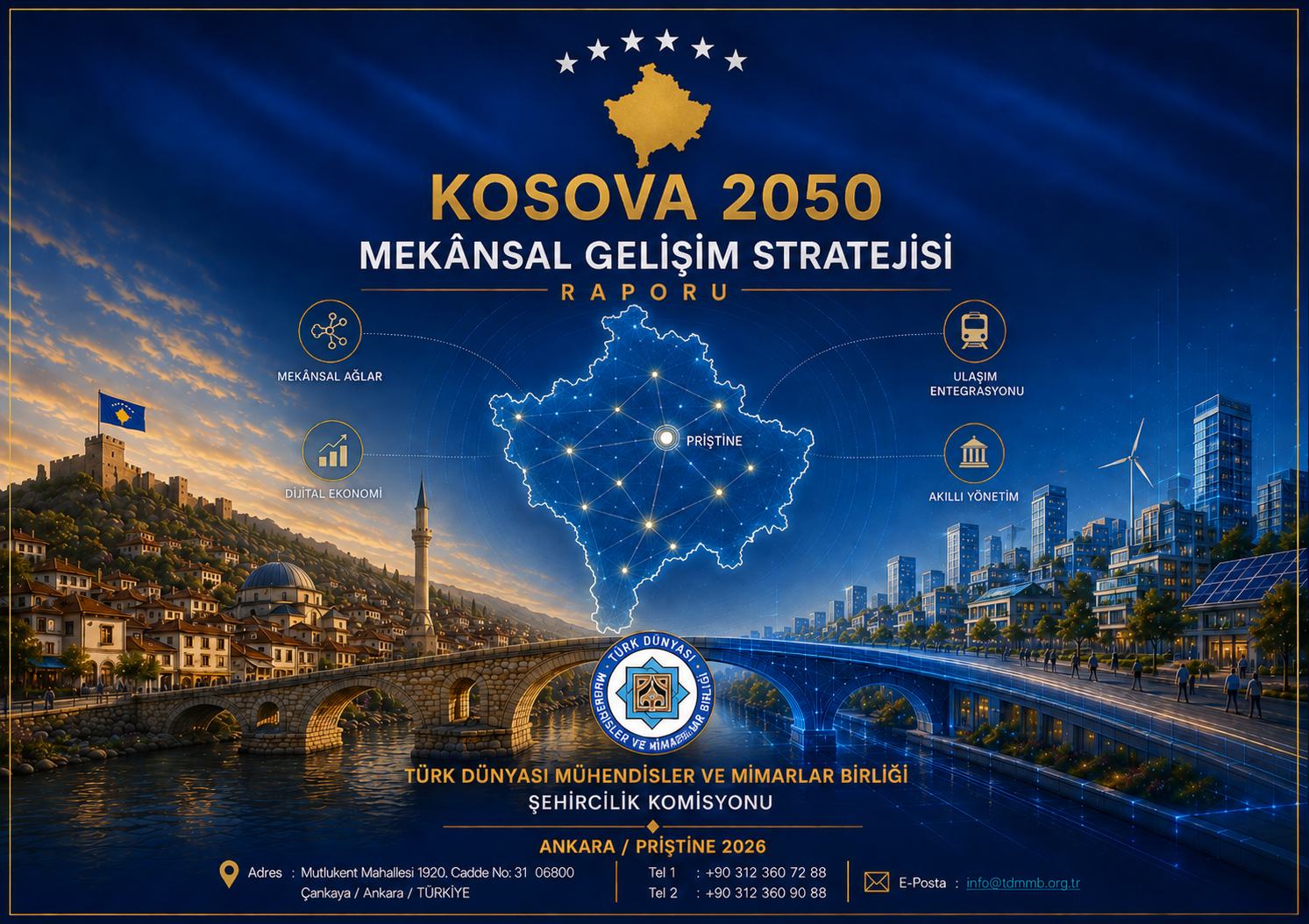
Kosovo 2050 Spatial Development Strategy
ND İmar prepared this report pro bono, coordinated by the Urban Planning Commission of the Union of Turkic World Engineers and Architects (TDMMB) with input from its environment, transport, disaster management, energy, science-industry, culture, tourism and foreign relations commissions. It assesses Kosovo's natural, social, economic and legal-administrative structure as a whole and proposes a workable development framework to 2050.
“In 2050 Kosovo will be the regional centre of sustainable liveability and prosperity: protecting its natural and cultural heritage, resilient to climate change, economically strong and innovative, socially inclusive, equal and safe, with a high quality of life and spatial design rooted in aesthetics and identity.”
Four strategic axes
Green & resilient environment
Protection belts around drinking-water basins, basin-based water management, blue-green infrastructure, low-emission zones, flood, landslide and fire risk built into plans.
Inclusive & resilient society
Urban growth boundaries, renewal of unsafe buildings, fair access to education and health, heritage protection, shared public spaces.
Sustainable & innovative economy
Organised industrial zones and technology parks, renewable energy, railway modernisation, farmland protection, tourism and the digital economy.
Effective & transparent governance
Aligning planning law with the EU acquis, digital e-permits, shared data infrastructure, a planning inspection board, monitoring and evaluation.
Selected indicators of the current situation
| Indicator | Value |
|---|---|
| Buildings built without a permit | %75+ |
| Farmland lost to sprawl each year | ≈ 500 ha |
| Winter PM10 and PM2.5 against EU limits | 2–3× |
| Renewable water per person | 1.600 m³/yıl |
| Resident population change, 2011–2024 | −8,8 % |
| Exports / imports, 2024 | 0,94 / 6,3 mlr € |
| Electricity from lignite | %90+ |
| Diaspora remittances as share of GDP | %15–18 |
Method and preferred future
SWOT, PESTLE, a Regional Economic Impact Model, scenario analysis and multi-criteria decision analysis were used together. Four scenarios were compared: EU integration and sustainable development, business as usual, environmental and economic crisis, and a resilient society with local development. The preferred scenario is an integrated one that strengthens EU integration, sustainable development and local resilience together.
Seven planning sub-regions and 2050 targets
The strategy moves Kosovo from single-centre growth to a balanced polycentric settlement system. Pristina keeps its capital role while each region is strengthened in its own speciality.
| Region | 2050 identity | 2050 target |
|---|---|---|
| Pristina | Green metropolis; digital and finance hub | 15 m² green space per person; €1 bn ICT exports; carbon-neutral transport |
| Prizren | Culture and gastronomy centre | 600,000 tourists a year; €150 m tourism revenue |
| Ferizaj | Balkan logistics hub | 1.5 m tonnes of rail freight a year; 20,000+ jobs |
| Peja | Eco-tourism and organic farming centre | 400,000 nature tourists a year; €100 m organic exports |
| Gjakova | Sport and cultural tourism centre | €50 m wine exports; legacy of the 2030 Mediterranean Games |
| Mitrovica | Green industry and energy centre | 300 ha of mining land restored; 50% renewable energy |
| Gjilan | Modern farming and sport centre | 100% rise in farm productivity; 90% irrigation coverage |